
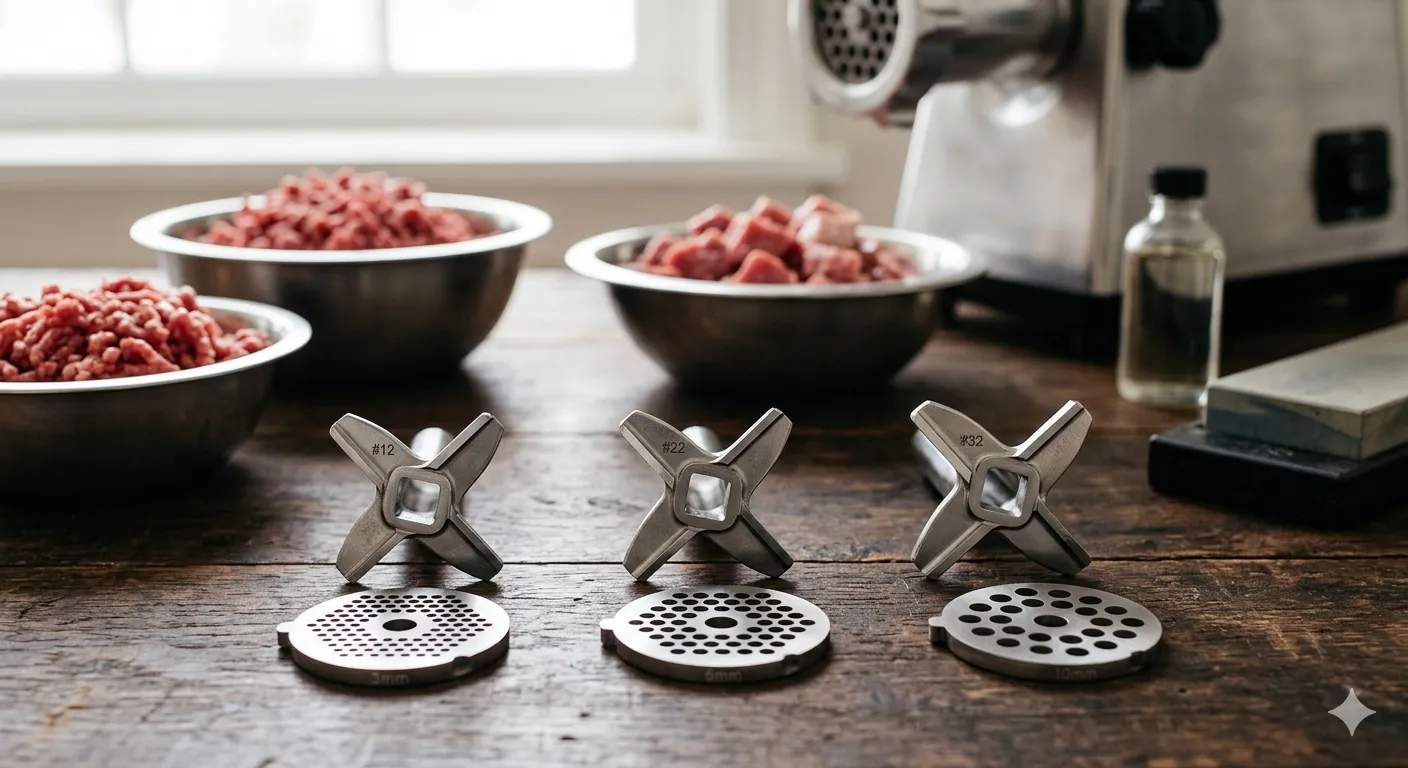
Meat grinder blades: A professional guide to sizes, maintenance, and performance
The performance of a meat business or a high-production kitchen depends directly on the quality of its cutting tools. If you notice that your meat is coming out with a mushy texture, losing excessive juices, or that your equipment’s motor is straining, the problem isn’t the machine’s power; it is time to check your meat grinder blades.
Keeping a cutting system sharp and properly matched is the only way to guarantee a clean grind, preserve the cold chain, and ensure the freshness of the final product. In this guide, we will teach you how to identify when to change your components, how to accurately measure your parts, and the technical secrets to extending the lifespan of your investment.
How to choose the exact size of your blades and plates
The most common mistake in the food industry is buying components based solely on visual appearance. Using the wrong size can destroy the feed screw or prematurely wear out the grinder head.
To identify which spare part you need (such as the popular sizes #12 #22 or #32), you must measure the outside diameter of the plate or the opening of the grinder head output, along with the diagonal of the knife and its respective square center hole.
Use the following standard technical reference table to select your replacement knives and plates without any margin of error:
| Grinder Size | Plate Diameter (Inches) | Blade Diagonal (Tip to Tip) | Square Hole Dimension |
| #5 | 2 1/8″ (54 mm) | 1 13/16″ | 0.375″ (9.5 mm) |
| #8 | 2 1/2″ (63.5 mm) | 2 1/4″ | 0.4375″ (11.1 mm) |
| #10 / #12 | 2 4/7″ (69.8 mm) | 2 1/2″ | 0.468″ (11.8 mm) |
| #20 / #22 | 3 1/4″ (82.5 mm) | 2 7/8″ | 0.520″ (13.2 mm) |
| #32 | 3 7/8″ (98.4 mm) | 3 1/2″ | 0.578″ (14.6 mm) |
| #52 | 5 1/8″ (130.1 mm) | 4 1/2″ | 0.860″ (21.8 mm) |
The secret to a perfect match: Plate and blade always together
In meat processing, there is an unbreakable golden rule: the blade and the plate must wear out together. Both elements work on a friction and cutting principle similar to a pair of scissors.
When a blade rotates against a plate, both micro-surfaces seat against each other through daily use. If you decide to install new replacement knives on an old, worn plate, micro-gaps will form between the two components.
The result? The meat will not be cleanly sliced; instead, it will be chewed and smashed under pressure, clogging the holes, raising the product temperature, and overheating the equipment’s motor. Always replace both elements as a matching set to ensure optimum performance.
Pro-Tips for maintenance to prevent jams and dulling
- Freeze the fat before processing: Soft fat at room temperature sticks to the walls and bends the blade edges instead of slicing cleanly. Keeping your raw material between -2°C and 0°C guarantees sharp, clean cuts.
- Correct tension adjustment: Do not over-tighten the grinder’s front ring nut using improvised mechanical tools. Excessive pressure creates extreme friction, generates heat, and accelerates the need for a sharpener or a total replacement. Tighten firmly using only the strength of your hand.
- Post-wash lubrication: Hardened and carbon steel is highly susceptible to rust. After cleaning your parts, dry them immediately and apply a thin layer of food-grade mineral oil to protect the cutting edges.
Frequently Asked Questions about grinder cutting systems
Can I sharpen my blades with a conventional sharpener?
It is not recommended for professional use. Blades and plates require a completely flat and uniform surface grinding. An asymmetrical manual sharpening will ruin the contact point between the parts, causing smearing and poorly textured meat.
What is the difference between hubbed and reversible plates?
Flat or reversible plates allow you to use both sides of the cutting surface, effectively doubling their operational lifespan. Hubbed plates protrude on one side to make removal easier and to ensure a fixed alignment in heavy-duty industrial grinders.
How often should meat grinder blades be replaced?
For professional butcher shops with a constant workflow, it is advised to replace them every 3 to 6 months. If you are a home cooking enthusiast or process meat seasonally, the cutting set can last a year or more under a strict lubrication and cleaning protocol.
Invest in quality: Optimize your production today
A poor cut ruins your product presentation and slows down your workflow. Using replacement parts that meet the highest standards of alloy and technical precision is the most cost-effective business decision in the long run.
Find the most comprehensive catalog of premium components, grinding kits, and certified replacement parts designed to withstand the most demanding shifts in the meat industry.
Ensure the maximum efficiency of your equipment and discover the difference of a professional cut by visiting our specialized catalog at https://nbsparts.com.